
Since 1980
Where Threads Become Heirlooms
Three generations of master artisans in Bhadohi — India's Carpet City — weaving pure New Zealand wool into rugs that will outlive us all.
The Place
Bhadohi: The Carpet City of the World
In the dusty plains of Uttar Pradesh sits Bhadohi — a town that produces more handmade rugs than anywhere else on earth. The craft arrived here in the 16th century, brought by Persian weavers travelling with Mughal armies. Four hundred years later, Bhadohi's master artisans are still tying knots by hand, in workshops that have been in the same families for generations.
Rugkari was founded in 1980 in the heart of this craft tradition. We started with a single hand-knotted loom, ten weavers, and a conviction: that a rug should be made the way it was always meant to be made — by patient hands, from natural fibres, designed to last lifetimes rather than seasons.
The Material
Why Pure New Zealand Wool
Every Rugkari rug uses 100% pure New Zealand wool — the gold standard for luxury rug-making. New Zealand wool is naturally crimped (giving rugs resilient pile that bounces back from foot traffic), contains natural lanolin (a built-in stain barrier), is naturally flame-retardant, and has a finer fibre diameter than most domestic wool varieties.
We do not use synthetic fibres. We do not blend. We do not compromise. The result is a rug with a hand-feel that simply cannot be replicated with polyester, polypropylene, or even most blended wools.
The Craft
How a Rugkari Rug is Made
1. Wool sourcing & preparation
Pure New Zealand wool fleeces arrive at our Bhadohi facility, where they are carded, spun, and dyed using azo-free reactive dyes. Our colour formulations have been refined over four decades to produce stable, fade-resistant hues.
2. The artisan's hand
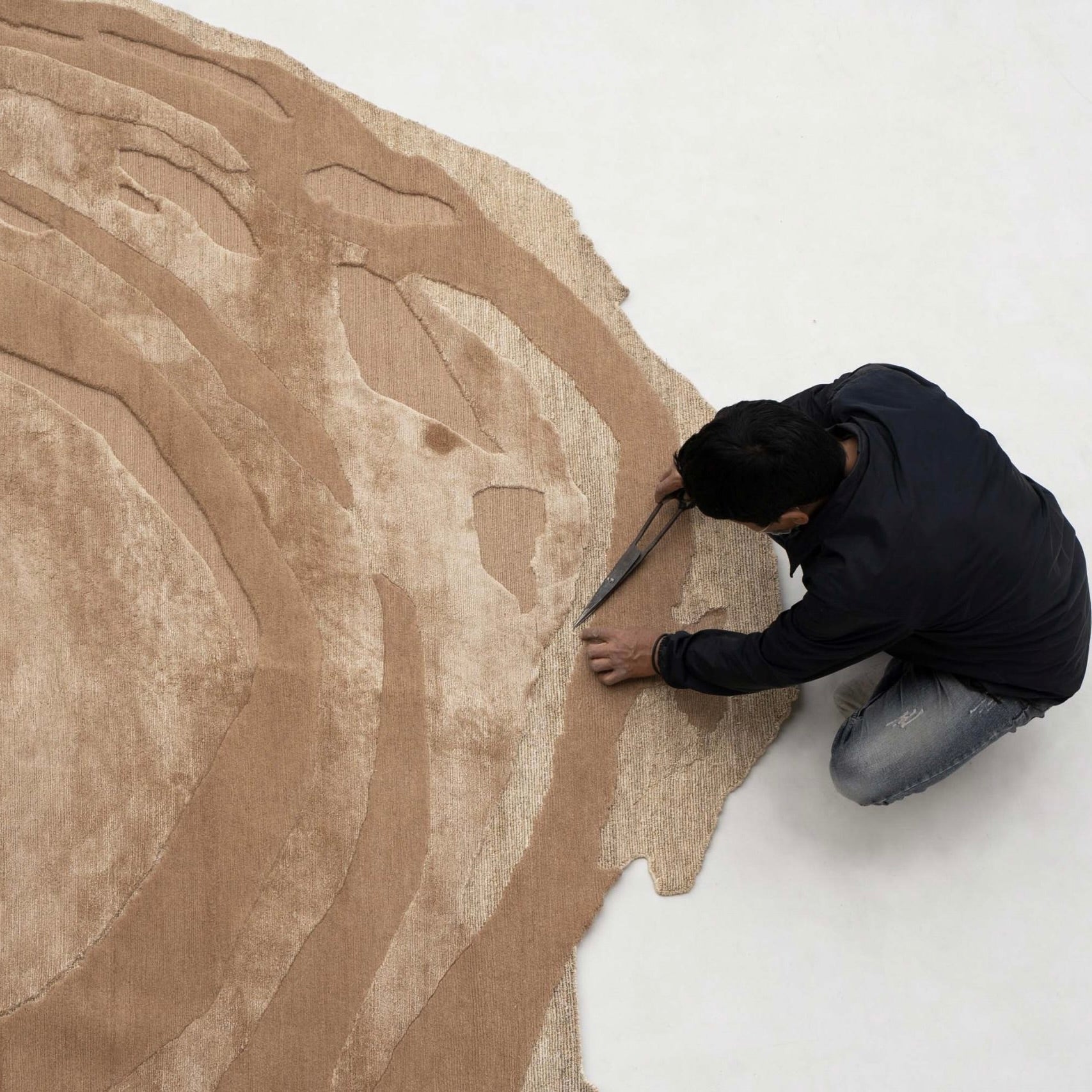
Each rug is assigned to a single master artisan. Hand-tufted rugs are made by pushing yarn loops through a canvas backing with a tufting gun — a labour-intensive process where the artisan literally draws the design with wool, working from the back of the canvas while the design takes shape on the front. A standard 6×9 ft rug takes 14–18 days of continuous work.
Hand-knotted rugs take far longer — each individual knot is tied by hand, with our finest pieces reaching 300 knots per square inch (KPSI). A premium hand-knotted rug can take 6–10 months to complete.
3. Finishing
Once woven, the rug is washed, sheared to even out the pile height, and finished by hand. Hand-tufted rugs receive a latex coating to secure the knots, then a cotton canvas backing. Hand-knotted rugs are reversible and require no backing.
4. Quality & warranty
Every Rugkari rug is inspected by our master quality controller before shipping. Each piece comes with a 10-year heirloom warranty against manufacturing defects.
Our Promise
Built to Outlive Us
A Rugkari rug is not bought to be replaced. It is bought to be passed on. Every piece carries a 10-year warranty, but with basic care, our hand-knotted rugs can last 30 years or more. We're in this for the long generations.
Explore the Collection


